
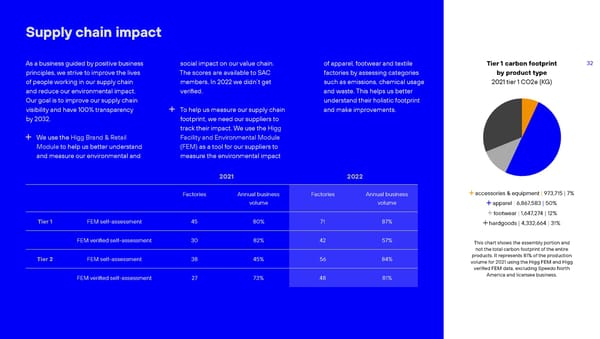
32 Supply chain impact As a business guided by positive business principles, we strive to improve the lives of people working in our supply chain and reduce our environmental impact. Our goal is to improve our supply chain visibility and have 100% transparency by 2032. We use the Higg Brand & Retail Module to help us better understand and measure our environmental and social impact on our value chain. The scores are available to SAC members. In 2022 we didn’t get verified. To help us measure our supply chain footprint, we need our suppliers to track their impact. We use the Higg Facility and Environmental Module (FEM) as a tool for our suppliers to measure the environmental impact of apparel, footwear and textile factories by assessing categories such as emissions, chemical usage and waste. This helps us better understand their holistic footprint and make improvements. 2021 2022 Factories Annual business volume Factories Annual business volume Tier 1 FEM self-assessment 45 80% 71 87% FEM verified self-assessment 30 82% 42 57% Tier 2 FEM self-assessment 38 45% 56 84% FEM verified self-assessment 27 73% 48 81% Tier 1 carbon footprint by product type 2021 tier 1 CO2e (KG) accessories & equipment | 973,715 | 7% apparel | 6,867,583 | 50% footwear | 1,647,274 | 12% hardgoods | 4,332,664 | 31% This chart shows the assembly portion and not the total carbon footprint of the entire products. It represents 81% of the production volume for 2021 using the Higg FEM and Higg verified FEM data, excluding Speedo North America and licensee business.
 Positive Business Report Page 31 Page 33